|
Back to the index
Intervention by Roberto Quaglia (Lista Pannella)
  When I was a boy and went to school, I remember that among various things I was taught the broad outlines of the history of America. One of the most horrifying phenomena they taught us of the history of America was the abomination of the colossal slave trade that centuries ago marked an entire epoch. The slave traders landed with their ships on the African coasts, burst in armed among the defenceless local tribes and literally kidnapped thousands upon thousands of human beings who, like cattle, were transported to America to be reduced to slavery in the cotton fields and elsewhere. Then came the war of secession. As we know, the northerners won, slavery was abolished, and all was well that ended well. When I was a boy and went to school, I remember that among various things I was taught the broad outlines of the history of America. One of the most horrifying phenomena they taught us of the history of America was the abomination of the colossal slave trade that centuries ago marked an entire epoch. The slave traders landed with their ships on the African coasts, burst in armed among the defenceless local tribes and literally kidnapped thousands upon thousands of human beings who, like cattle, were transported to America to be reduced to slavery in the cotton fields and elsewhere. Then came the war of secession. As we know, the northerners won, slavery was abolished, and all was well that ended well.
It is therefore perhaps by virtue of this common cultural heritage of ours that in recent years I have had to realise with growing dismay that such horrors of the past, which — I believe — continue to be taught in Italian schools as such, are anything but dead and buried. Worse, such horrors are among us, among us Italians, among us Genoese, and this is why the matter closely concerns our City Council too, because we, we Italians, we Genoese, are full participants in these horrors, even if, for reasons of the basest convenience, very few of us care to realise it and prefer to hide from ourselves and from others this infamous state of affairs.
For anyone so blind as not yet to have understood what on earth I am talking about, I specify that I am referring to the trafficking of human beings for the purpose of sexual exploitation. A detailed and reliable study by Caritas, Parsec and the University of Florence estimates that there are today in Italy from 19,000 to 25,000 foreign girls engaged in prostitution, almost all of whom are in a condition of slavery. I repeat the point: from 19,000 to 25,000 girls, almost all of whom live in a veritable condition of slavery! It is not my opinion, Mr President, Mr Mayor, ladies and gentlemen colleagues. It is an objective situation of fact, emerging incontrovertibly from the proceedings of a recent seminar promoted on the subject by Caritas Italiana, the most significant arguments of which I have taken up among the preambles in the motion I am illustrating, and therefore I do not repeat them in full in this intervention of mine.
So tens of thousands of slave women among us, like tens of thousands of slaves in that distant slaveholding America that in words — alas, often only in words — we are all so ready to condemn without doubt or appeal. Of course, it is not the same thing, someone will say. But, I reply, the differences that do exist do us no honour at all, since they are apparent and not substantial differences, a hypocritical veil serving as an alibi for consciences.
Ah, yes, ladies and gentlemen, slavery in Italy today exists, but for the end users of this abomination — those for whom it is carried out — it is not convenient to know that it is slavery. It might spoil their groinal pleasure. Modern slavery disguises itself to spare qualms of conscience to those who make use of the services it offers. In Genoa as in Italy, ladies and gentlemen, today one goes whoring — and you will forgive me if I cite Reality with the language of reality — in the mistaken belief of paying a free girl who has freely chosen to perform sexual services in exchange for money. Instead, in the majority of cases, it is not so at all. The reality is different from how, for convenience, it appears. Most of the girls are lured into our country by deception, and once here, with us, in Italy, a country we like to believe free, they are reduced to slavery.
Going to split hairs in Man, it is not at all unfounded to suppose that even in the times of slavery in America, the beneficiaries of the services performed by the slaves had little awareness of the reprehensible aspect of the phenomenon they took part in. After all, it was not they who had kidnapped human beings and reduced them to slavery. They paid for the slaves at the moment of purchase, then housed and fed them for their natural life in exchange for their labour. Probably, in their eyes there was nothing strange or reprehensible. After all, even today the free world is full of people who with their labour barely manage to secure the necessary food and lodging. Not to mention the jobless in countries where not to work is to die of hunger at once. The American slaveholders therefore probably had an excellent opinion of themselves and of what they did, since evidently they saw nothing wrong in it, just as many Italian citizens, today, consider it perfectly normal and convenient to avail themselves more or less systematically of the sexual services of the slave women offered to them in the street. The act of paying for the service in fact frees the client from any suspicion of having abused a slave. But we know that that money will end up in the pockets of the slaveholders, to whom those girls literally belong.
Moreover, there is another argument to consider: the human psyche is a most curious matter. Human beings, especially when they are young, acquire their own identity on the basis of what they habitually do. Which is why most of these little girls thrown onto the pavement against their will, after some time resign themselves to being what they have been forced to become. Let this serve as an alibi for no one. Even in the time of slavery in America, most of the slaves in the end had nothing left but the identity of a slave. Many of those who were born slaves down there did not dream at all of one day being freed, so much were they slaves mentally too. None of this justifies either the slavery of then or that of today.
But what truly disturbs me, I must confess, is not exactly the fact that today in Italy, as well as today in Genoa, slavery is practised and that Italian and Genoese citizens are its users. From the mass of human beings, I have resigned myself to expecting little more. What disturbs me is that the very institutions of our civil society are practically inert and indifferent in the face of such a state of affairs. Here and there someone is outraged, it is true. But they are isolated individuals. And they are of little use. The institutions as such are on this matter still, motionless, entirely useless, busy with quite other affairs. This state of affairs must change rapidly. It is intolerable that a country that calls itself civil, in which everyone competes to protect the rights of anyone at all provided the matter ensures economic or electoral returns, should keep its eyes most tightly shut so as not to see and not to oppose the shameful violation of human rights that in our country today is committed with the enduring forced sexual exploitation of young foreign girls who have dreamed of a better life in our country, and to whom our country today instead reserves only slavery and rapes. If my words sound melodramatic to someone, I guarantee that they are instead far less dramatic than the atrocities that the girls deported — Yes! Deported! — to our country are forced to suffer. Last 25 April, the Feast of the Liberation — and God only knows how many thousands of foreign girls today in Italy dream of being liberated from their deportation to Italy — last 25 April near Trezzo sull'Adda, an Albanian girl was found dead. The left side of her face was torn off by three hammer blows. The body was disembowelled from the trachea to the pubis and from kidney to kidney. Disembowelled in the shape of a cross to extract the three-month-old child she was carrying in her womb. Ostentatiously disembowelled to show the other slaves what would happen to anyone who tried to escape prostitution by conceiving a child. This too is Italy today. One must open one's eyes, realise it and act accordingly.
In Genoa, as in the rest of Italy, human rights are violated today! How many times has this Council stopped to spend words to commemorate horrors distant in time, to stigmatise human rights violated elsewhere? All well and good, all sacrosanct and we know it well, but on condition of not neglecting the biggest horror of all because of the fact that it concerns us directly, we being participants in it. Yes, participants! Where there is no demand, no market develops. The trade in slave women in Italy today exists because it suits many Italians for it to exist, even if out of cowardly hypocrisy they pretend it does not, and because to the other Italians, who do not make use of the slave women, the fate of these matters little if not nothing.
When France recently carried out its well-known nuclear explosions, a part of us Italians boycotted the market of French products. Why has none of these virtuous people ever loudly called for a boycott of the market of slave prostitution? A part of us Italians every so often even loudly invokes the boycott of one television network or another. Why has none of these virtuous people ever loudly called for a boycott of the market of slave prostitution? In Italy people gladly boycott everything: from taxes to rules, from farmed mink furs to the books of non-farmed intellectuals. At referendums. Far be it from me to contest the reasons of any boycott. Everyone is free to boycott whatever they most please. But I ask myself: why has none of these virtuous people ever loudly called for a boycott of the market of slave prostitution?
What is lacking in this regard in Italy is the awareness of what is happening. The Nazi concentration camps and the extermination of the Jews were possible because no one then in Germany, apart from the Nazi leaders, knew or wanted to know what was happening. Slavery today in Italy, all due proportions considered, prospers for the same reasons: the indifference and blindness of all that leave a free hand to a few criminals.
What can we do, our small and modest City Council, to face with dignity this unworthy state of affairs? Not a great deal, in truth. But not little either. In reality, we can do exactly everything possible, that is, what it occurs to us that we can do about it, and which falls within our power to do. I have allowed myself a tautology, to highlight our duty to leave nothing untried in order to face this kind of situation as one ought.
First of all, we must fully realise the gravity of the problem. I doubt that such awareness already exists, in this Council, to the due degree. I recall that when for the first time, in the conference of Group Leaders, I mentioned the fact of having in preparation a motion on the problem of slavery in Genoa, I provoked hilarity in some colleagues — and even in an assessor! In this regard, I quote verbatim the words recently spoken by Minister Livia Turco: "...discussing the 'trafficking' with a journalist already sensitive to the problem, I noticed that my interlocutor remained for a moment astonished at the kind of terminology I used."
These are the words of Minister Livia Turco. We witness without seeing it — our eyes lined with television hams — a veritable trafficking of slave women, which the conscience struggles to grasp in all its cruelty, so much does it seem to have come out of an improbable nightmare of dark medieval recurrences. And yet, we must realise the gravity of the situation, otherwise we will never have the strength to think and to do something truly useful towards overcoming this drama.
Again Minister Livia Turco, on the same occasion, asserted: "It will therefore be right to involve the local Administrations, so that they intervene and support the proposals and take on the problem." I agree. The cities are the place where the problem asserts and concentrates itself. It is in the cities that the infection of modern slavery has its worst outbreaks, it is in the cities that the antibodies must be mobilised to return to a civic health worthy of the name. We have few weapons. We must use them all. We must first of all foresee and quickly make operational facilities capable of receiving and protecting all the slave women who should decide to attempt to flee from their horrible condition. It is an inescapable imperative. As an Administration, we may not perhaps have the power to physically wrest the victims from their tormentors, but it would be the most shameful failure to render aid not to prepare ourselves to receive and help the girls who, at the risk of their own life and that of their loved ones — who are not rarely held hostage in their countries of origin — should dare to attempt to flee from their hell. I believe that some time ago the Administration announced the establishment of an observatory on this problem. I hope it did. But to observe is no longer enough! One observes a panorama; in the face of a drama one intervenes! Without my wishing to disrespect anyone, I warn that the observation of the problem not followed by concrete initiatives would risk degenerating into a fatuous and sterile voyeurism. I do not believe this is the will of the council executive, and I allowed myself the previous sentence to impress as indelibly as possible upon us all the urgency of a concrete and tangible turning point in the commitment of us all to the fight against slavery in our city and in our country. As said, we have few instruments. But David felled Goliath with a sling.
Information is our best vaccine. We must inform the hundreds or thousands of girls who in our city live in a condition of slavery of all their rights and opportunities. The slave women are generally indoctrinated to fear the forces of order and the Italian institutions even more than their jailers. This lie must be dispelled. I urge the city Administration to print periodically booklets drawn up in the languages generally understood by the girls deported to our city, in which their rights and the opportunities that the Italian state and our Municipality offer for their protection are clearly illustrated. Let such booklets be distributed extensively among the prostitutes who in the evening crowd the pavements and in the other environments where it is suspected that the slave girls may be kept hidden. Let the same information be repeated on posters put up throughout the city. Let an awareness campaign be launched, directed at all our fellow citizens, on the exact characteristics of this infamous state of affairs. The young lad who in the evening cheerfully loads a beautiful foreign girl into his car to amuse himself a little, will perhaps think twice knowing that it is his act, added to that of the others, that feeds a market in slave women which without demand would not exist. He will think twice and then perhaps do it all the same, but meanwhile he will have thought twice, and another two times he will think the next time. By dint of thinking, sooner or later, something new might even occur to him. It might occur to him, that is, that the pleasure of his transgression is suddenly less than the annoyance of knowing himself a causal element and user of a trafficking of slave women, and then, and only then, perhaps he will give up his whim.
Inform, inform, inform! Inform the slave women of the opportunities offered to them, inform the citizens of the crime in which they take part by using the slave women, inform our highest offices of the State of the necessity of urgent legislative and organisational measures on the matter and of our full availability and will to act at once. Inform the highest international bodies of our resolutions, and urge them to take action on these matters. Contact all the other Italian provincial capitals to inform them of our decisions and establish bonds of cooperation. Inform, that is the first thing to do. The others follow. I hope they are done. If the Italians do not manage to overcome the present infamy of this enduring mass deportation of thousands of girls into slavery, taken from their norms and their distant families to be reduced to forced sex flesh on the Italian pavements, for the unthinking sexual satisfaction of so many fine Italians, there will truly, but I say truly, be cause to be ashamed of being Italian.
Years ago, urban legends evoked the spectre of a white slave trade, girls kidnapped in our countries and sold to obscure Bedouin sheikhs of distant lands, in whose harems they would remain forever shut away. Probably such legends had something of the true in them. No person who has ever been in such phantom harems has ever come back to tell of it. How would each of us feel if our own daughter were kidnapped and condemned to satisfy for her whole life the cravings of some wretched sultan of his own oasis in the middle of a forgotten desert? Fortunately this never or almost never happens. What is certain instead is that today the reverse happens. It is we Italians who are, for some distant parent and for the terrified mind of the girls deported to us, the foul sultans who with contempt for everything relieve themselves where, despite the false appearances, it is not at all required that such needs be relieved. Let us take note of it, and act accordingly in every possible way.
Roberto Quaglia
To the Honourable Mayor
of the Municipality of Genoa
Order of the Day
o n  t h e e m e r g i n g p r o b l e m o f t h e e m e r g i n g p r o b l e m o f
a s l a v e r y f o r p u r p o s e s o f
a p r o s t i t u t i o n i n G e n o a a s i n t h e o t h e r I t a l i a n c i t i e s
The City Council of Genoa
Whereas it is noted that
in the Supplementary Convention on the abolition of slavery, the slave trade and institutions and practices similar to slavery, signed at Geneva on 7 September 1956, one reads among other things:
- PREAMBLE:
- Considering that freedom is a right that all human beings acquire at birth;
- Conscious of that which the people of the United Nations have confirmed in the Charter, their faith in the dignity and worth of the human being;
- Considering that the Universal Declaration of Human Rights, which the General Assembly has proclaimed as a common ideal to be attained for all peoples and all Nations, provides that no one shall be held in slavery and that slavery and the slave trade are abolished in all their forms;
- Recognising that, since the conclusion, at Geneva, on 25 September 1926, of the Convention on slavery, which aims to suppress slavery and the slave trade, new progress has been made in this direction;
- Bearing in mind the Convention of 1930 concerning forced labour and that which has been done subsequently by the International Labour Organisation and that which concerns compulsory forced labour;
- Having found nonetheless that slavery, the slave trade and institutions and practices similar to slavery have not yet been eliminated in all the regions of the world;
- Having decided in consequence of the Convention of 1926, which is still in force, to make use of a Supplementary Convention intended to intensify efforts, both national and international, aimed at abolishing slavery, the slave trade and institutions and practices similar to slavery;
- SECTION ONE
- Article one.
Each State participating in the present Convention shall take all measures, legislative and other, that shall be feasible and necessary to obtain progressively and as soon as possible the complete abolition of the following institutions and practices, where these still exist, that is those which fall or do not fall within the definition of slavery appearing in Article 1 of the Convention on slavery signed at Geneva on 25/9/1926;
- a) debt bondage, that is the condition resulting from the fact that a debtor is pledged to provide, as security for a debt, his personal services or those of someone over whom he has authority; if the value of these services is not destined to the liquidation of the debt or if the duration of these services is not limited, nor their character defined, there is debt bondage;
- b) serfdom, that is the condition of anyone who is bound by law, custom or agreement, to live and to work on land belonging to another person and to provide to this other person, in exchange for compensation or gratuitously, certain determined services, without being able to change this condition;
- c) All institutions, that is practices, by virtue of which:
- I) a woman, without having the right to refuse, is promised in marriage in exchange for a
- consideration in money or in kind paid to her parents, her guardian, her family or other persons or groups of persons;
- II) the husband of a woman, the family or others have the right to transfer the woman to a third party, for value or otherwise;
- III) the woman may, after the death of her husband, be inherited by another person;
- d) any institution or practice by virtue of which a child or an adolescent under 18 years of age is delivered, whether by his parents, or by one of them, or by his guardian, to a third party, with payment or not "on delivery", with a view to the exploitation of the agreed labour of the child or adolescent.
- SECTION II (Slave trade)
- Article 3
- The act of transporting or attempting to transport slaves from one country to another by any means of transport whatsoever, or the act of being an accomplice in these activities, shall constitute a criminal offence under the law of the States Participating in the Convention, and persons found guilty of such an offence shall be liable to very severe penalties.
- a) The participating States shall take all effective measures to prevent the ships and aircraft authorised to travel through their territory from transporting slaves, and shall take all effective measures to punish the persons guilty of these acts or guilty of using the national territory for this purpose;
- b) The participating States shall take all effective measures so that their ports, their airports and their coasts cannot serve for the transport of slaves.
- The States participating in the Convention shall exchange information in order to ensure the practical coordination of the measures taken by them in the fight against the slave trade and shall inform one another of all cases of slave trade and of all attempts at infringement of this kind of which they shall be aware.
- Article 4
All slaves who take refuge on board a ship of a State participating in the present Convention shall be free "ipso facto".
- SECTION IV (Definitions)
- Article 7
For the purpose of the present Convention:
- a) Slavery, as defined in the Convention of 1926, is the status or condition of an individual over whom the attribution of the right of ownership is exercised, and the slave is the individual who is in this condition.
- b) The person "in a condition of slavery" is the one indicated in the Statute, that is in the condition resulting from one of the institutions or practices seen in Article one of the present Convention.
- c) The "slave trade" establishes and comprises all acts of capture, of acquisition or of transfer of a person in order to reduce them to slavery, all acts of acquisition of a slave with a view to selling or exchanging them, as well as in general all acts of commerce and transport of slaves and those that are the means of transport used.
- SECTION V (Cooperation between the Participating States and communication of information)
- Article 8
- The States Participating in the Convention have undertaken to one another to offer mutual assistance and to cooperate with the United Nations Organisation with a view to the provisions listed previously.
- The States Participating in the Convention shall undertake to communicate to the Secretary General of the United Nations a copy of all the laws, all the regulations and all the administrative decisions adopted or put into force to give effect to the provisions of the present Convention.
- The Secretary General shall communicate the information acquired, by virtue of the second paragraph of the present Article 8, to the Participating States and to the Economic and Social Council, which shall adopt these discussions as documentation on which to deliberate and shall proceed to put forward new recommendations regarding the abolition of slavery, of the slave trade or of the institutions and practices that are the object of the Convention.
- SECTION VI (Final clauses)
- Article 9
No reservation to the Convention shall be admitted.
- Article 15
- The present Convention, of which the English, Chinese, Spanish, French and Russian texts shall be equally authentic, shall be deposited in the archives of the Secretariat of the United Nations. The Secretary General shall prepare certified copies of it suitable for informing the States Participating in the Convention as well as all the other Member States of the United Nations and the specialised Institutions.
- In witness whereof the undersigned, duly authorised by their respective Governments, have signed the present Convention on the date represented by their respective signatures.
- Signed at the European Office of the United Nations, at Geneva, on 7 September 1956.
having established that
- In the text of the ruling of the Constitutional Court of 8 June 1981 no. 96 we find that...
"The notion of slavery or a condition similar to slavery understood as a condition of law contemplated in articles 600-602 of the code ... did not take into account art. 1 of the Geneva Convention of 25 September 1926, which became internal Italian law with royal decree of 26 April 1928 no. 1723... and renewed in the Geneva Convention of 7 November 1957 approved by law of 20 December 1957 no. 1304. In the list of the various situations that the Convention considers institutions and practices similar to slavery, several of them are situations of fact and not of law because they can be brought about without any legislative act or fact authorising them."
- And in the text of the ruling of the Court of Assizes of Florence, 23 March 1993, we find that...
"slavery and the similar condition must be deemed normative elements of the offence, the assessment of which may commonly be carried out either by the standard of a legal norm that qualifies — positively or negatively — a specific situation of fact as slavery or a similar condition, or in application of historical-social parameters, which allow the repression of phenomena characterised by the same aspects of offence against the individual personality that connote the historically known forms of slavery."
- And that according to the Court of Cassation, criminal section V, 7 December 1989 in Dir. famiglia 1990, 1095...
"Anyone who reduces a person (especially if a minor) to a condition similar to slavery, or acquires a person found in the aforesaid condition, cannot invoke the inevitable ignorance of criminal law: these are in truth norms conforming to the principle of recognisability, that is, such as to be perceived also as extra-penal norms of civilisation, undoubtedly in force in the socio-cultural environment within which the norms themselves operate."
having taken note that
CARITAS ITALIANA, together with MIGRANTES, USMI, UISG, ASPE, held on 6-7 December 1996 in Rome a study seminar on the theme "Trafficking of human beings for the purpose of sexual exploitation", from the proceedings of which the following data and arguments are drawn:
- On the eve of the year 2000 we find ourselves observing a phenomenon we believed gone forever: slavery. Today the immigrant woman and minor are reduced to slavery, in order to be an object of pleasure, sexually exploited.
This phenomenon, analysed by us, involves thousands of immigrant women, deluded, deceived and then prostituted, forced, that is, by violence to prostitute themselves, by Italian and foreign criminal organisations that have invented every form of blackmail, including emotional, in order to obtain easy gains and offer "human merchandise" to be sexually consumed.(Caritas Italiana, Migrantes, Usmi, Uisg, Aspe)
- "THE TRAFFICKING OF WOMEN IS MORE PROFITABLE THAN THE TRAFFIC IN ARMS AND DRUGS": this statement made in 1983 by Jean Fernand Laurent, rapporteur at the United Nations for this issue, has not lost its relevance and also highlights the correlation that exists between the phenomena cited. It makes us at once conscious of the harshness and complexity of this, which is the reason for our gathering today: the trafficking of human beings, specifically women, for the purpose of sexual abuse.
(Pino Gulia, Caritas Italiana)
- DESCRIPTIVE TRAITS OF THE PHENOMENON
- The quantitative aspect... The national estimates presented by PARSEC (Association for social research and intervention in collaboration with the University of Florence) confirm a presence that oscillates between 19,000 and 26,000 units; but the figure could be much higher if one considers all the women made to transit through Italy and destined for other European countries.
- Flows and origins....
- Although with different strategies and with different levels of involvement and awareness on the part of the women, the common and distinctive trait of this phenomenon is the impossibility for the victims to intervene freely in the management of their own migratory project, hence the real condition of slavery to which they are forced.
- Between 1989 and 1991: in concomitance with certain events involving Europe and with the promulgation of law 39/1990 the flows increase notably, with significant arrivals also from Eastern Europe. From the legal point of view the arrivals are predominantly clandestine, often managed and coordinated by veritable agencies of traffickers, both Italian and foreign.
- Between 1992 and 1994: these are characterised by arrivals more substantial than the previous ones, mainly from Albania and Nigeria. As regards the arrivals from Albania, these are very young girls, predominantly unmarried, of urban origin, enticed by compatriots only a little older than themselves who, pretending to be in love and with the promise of an imminent marriage in Italy, convince them to emigrate and, at a later stage, force them to prostitute themselves. The Nigerian women are on average less young than the Albanian ones, unmarried, of urban origin, often with professional experiences of quite another kind. The Nigerian women are enticed by compatriots who advance the money necessary for the documents and the journey: this initial debt becomes one of the greatest bonds preventing exit from the traffic (currently the figure would be around sixty million lire). Finally, also substantial are the arrivals from Eastern Europe of girls engaged in street work and, it is hypothesised, inside night clubs and beauty centres.
- Currently: the Albanian and Nigerian presence still predominates. The socio-demographic characteristics of the women, as well as the testimonies of the operators, confirm a greater information about the activity to be carried out in Italy; however, greater awareness does not protect them from the subsequent and continual traumas to which they are subjected by the conditions of slavery in which they live. The most recent arrivals are characterised by girls coming from the inner villages of the countries and an ever younger age, especially for the Albanian women.
- Hypothesis of intervention...
(...) it is deemed appropriate to consider the following premises (...):
- That the phenomenon has local relevance and for this reason needs a network of work and support that intervenes at once, concretely, in favour of the victims.
- That the phenomenon has national and international relevance and that it therefore needs a lively and attentive political debate.
- That the subjects to whom the intervention is to be directed are on one side the women, to whom an immediate and concrete response is owed, and society as a whole, to which a responsible and non-sensationalist information on the theme and a medium- and long-term awareness work are to be directed, and on the other side the clients.
- Operational intervention on the victims: approach, reception, orientation, psychological and legal assistance, accompaniment along a path of autonomy within a perspective of coordination and network work among the different resources of the territory.
(Maurizio Ambrosini, Catholic University)
- Personalised projects, designed and carried out on the basis of the real needs of the persons (listening, reception, reconstruction of the personality, reconciliation with oneself and with others...)
- Itineraries with objectives and phases.
- Legal protection (regularisation, reporting, legal assistance...)
- Small forms of reception, in communities or families.
- Possibility of transfers for safety.
- Social, educational, occupational reintegration.
- Possibility of return to the homeland, with appropriate guarantees, for those who wish it.
- Liaison with Italian Embassies and Consulates in the countries of origin (visas) and with the Embassies of the countries of origin in Italy (support, documents, returns.....)
(Maria Teresa Tavassi, Caritas Italiana)
- THE TRAFFICKING OF FOREIGN WOMEN IMMIGRATED TO ITALY
... for almost all the new subjects who sell themselves in the street, the immigrant prostitutes, this is slave labour: they are brought by the trafficking of human beings for the purpose of sexual abuse. The research done by Parsec and the University of Florence in April 1996 for the Vienna conference estimates their number — according to privileged witnesses — at between 18,800 and 25,100. These are approximate data that would need further confirmation, but globally they give the dimensions of it.
(Don Fredo Olivero, Diocesan Caritas of Turin)
- Analysis of the situation
- The trafficking of African women (Nigeria, Ghana)
- The organised and massive immigration into Italy of African women from the sub-Saharan area (Nigeria in particular, Ghana with a Nigerian passport...), begun at the end of '88, had a strong increase in '89-'90 (above all in the last months when the Martelli law was under discussion), and continued to a lesser extent in '91 up to today.
- In Italy, according to data collected in the provincial capital cities in 1989, there are at least 6,000 Nigerian women arrived with a visa from the Italian Embassy in Nigeria (Lagos) who carry out the work of street prostitute.
- In the province of Turin alone there are over 600 who live there and represent almost all the Nigerian women present in the territory, and they engage in street prostitution throughout the region.
- They all come from the same areas of southern Nigeria, from the cities of Benin City, Lagos or from some inland town, and belong to the Ibo, Yoruba, Benin, Edo tribes.
- How they arrive in Italy
We report here the data of the testimonies of hundreds of girls, confirmed by proofs and objective findings.
- The arrival — for almost all, until 1991 — is the airport of Rome and lately Linate and Malpensa, and the departure — for all — is the airport of Lagos (Nigeria), with a transit visa of 3 to 15 days issued by the Italian embassy in Lagos, obtained through someone who "took to heart" their application, paying the equivalent of 4-5 million lire normally to Nigerian citizens who "have access to the consular offices of the Embassy", with whom they collaborate, and manage to obtain it, or in exchange or travel agencies near the embassy.
- The passport is obtained directly from the local police who prepare and sell it. They are "regular" passports, acquired through the criminal organisation. This applies also to those already in Italy: it will be sent to them by post, or through a friend or a relative.
- There are cases of women who had on the same day the refusal of a visa and — after a few hours — the visa thanks to the good auspices of these gentlemen and the payment of the corresponding "bribe". The transit visa would provide for an air ticket to other destinations but in these cases it is not needed.
- In these last years ('93-'96) citizens of Benin and Ghanaians are also arriving, via Paris or via Bucharest, Sofia, Larnaca, Moscow, Amsterdam and Brussels. The most numerous groups of Nigerian women arrived in Rome with a transit visa or collective entry visas for "religious pilgrimage to various Italian holy places" (the number of women registered for each visa is about 15-20). This until 1993.
- What solutions for immigrant prostitution subject to trafficking
- First of all the condition of life must be analysed. The problem must be faced in terms corresponding to reality: the prostitution of immigrant women is not prostitution "by choice", but by coercion; it is therefore a trafficking of women and men aimed at sexual exploitation. Significant and characterising is the condition of slavery or semi-slavery to which they are reduced, and not only the fact of selling themselves in the street or in closed venues.
- Today in Italy the dominant prostitution is the one that does not arise from the hardship of immigration but from international commerce. From many women their identity is taken away (with the removal of their personal documents): the possibility is taken away of documenting who they are, where they come from, when and how they entered and even their country and community of origin.
- In the trafficking, especially of African women, the family too is involved as a victim: there is the possibility of suffering blackmail, of violence by organised crime with strong connivance in the local institutions (especially the police).
- Their exit "from the street" also entails for them the risk of suffering violence from the organisation, which usually operates directly through collectors-controllers ("maman", "boyfriend", "compatriot-exploiter"). Not rare are the cases of disfigurement, knifings, gang sexual violence and sometimes the killing of those who escape the rules and invite others to take the same path.
- The experience of prostitution leaves a deep mark on the life of the person.
- There is therefore the path of recovery, of regaining their dignity as women who return to live again without selling their bodies. This requires (besides the exit from the world of bought sex) a time of pause, of reflection and a positive personal and social life experience, possibly inserted into the world of work.
- "Work in the street" also leaves physical marks: the risks to health are very great and sometimes the symptoms make themselves felt after many months (AIDS in particular).
- Prostitution in the East: the first response to the trafficking of Albanian women (1995-96)
- Almost all Albanian prostitution is forced, even if what convinced them to leave were misery, the lack of work, the destruction of the social fabric, the lack of prospects. And then because a girl who is "talked about" or of the street cannot return home: tradition, psychology, the sense of honour forbid it: it is a shame.
- Real prostitution is not accepted by Albanian culture (and did not exist except covertly in some dance venues run by the Egyptian-Albanian minority).
- According to the medieval laws of Lek Dukagjini — still accepted by tradition, above all peasant and mountain tradition — "a girl who was talked about could be married only with the bullet in her bridal dowry and could be killed on any occasion by the husband, father-in-law, brother-in-law or by the son because the bullet had been paid for by her family. On these occasions the father, taking the corpse of his daughter, had to say: 'Blessed be your rifle, O master of the house!'" (from an Albanian testimony). The trafficking for the purpose of sexual abuse also concerns some male minors in Turin and the phenomenon is not evident.
- The Albanian government, "convinced" by the investments made in the country with the earnings of organised crime, pretends not to see; the Albanian police profit directly from the documents and from facilitating the passages. There must therefore be a serious relationship between governments to put an end — on this side and on that — to organised crime, without half measures and with adequate and reliable pools of law-enforcement forces.
- The construction of prospects for all the victims of the trafficking
- INTERNATIONAL INITIATIVES IN THE FIELD OF THE TRAFFIC IN HUMAN BEINGS
- OPERATIONAL CONCLUSIONS
- One cannot ignore and keep silent in the face of a problem that arises within this phenomenon and that involves so high a number of persons.
- The trafficking of immigrant women reduces the woman to a state of exploitation and slavery: it is necessary to defend and restore the dignity of a human person to these women.
- They are women coming from the poorest countries of Eastern Europe and of the world.
- Many of these persons are minors.
- Many of them wish to get out of the circuit and seek support and protection.
- If the supply exists it is a sign that there is demand.
- This need is an index of the moral, social, civil decay of our Country, even if the problem extends to the European territory.
- Let serious thought be given to the possibility of a legislative revision that grants the residence permit to those who, minor or adult, decide to get out "of the circuit", whether or not they make a contribution to unmasking the criminal organisations.
(Elvio Damoli, Director of Caritas Italiana)
- STATEMENT OF MINISTER LIVIA TURCO
"I am ever more convinced that the problem today is not in prostitution, but a veritable phenomenon of trafficking. The press and the means of social communication must provide correct information on this phenomenon. Lately, discussing the 'trafficking' with a journalist already sensitive, I noticed that my interlocutor remained for a moment astonished at the kind of terminology I used. This, therefore, will have to be a first moment of contact for a common work: to provide correct information that involves the secular, political and religious authorities in raising awareness of the phenomenon. Ours must not be a work on its own. A network is needed, in order to have points of reference at institutional level. It will therefore be right to involve the local Administrations, so that they intervene and support the proposals and take on the problem."
considering that
- on the basis of the data and arguments set out above, together with the observation of what happens in the evening hours on the city pavements, it must be concluded that hundreds of girls in our city (like tens of thousands in our country) plainly and to all effects suffer one of the most infamous and unacceptable violations of human rights: reduction to slavery
- the end users of this colossal trafficking in white and black women are hundreds of thousands of male Italian citizens and, as regards our Municipality, thousands of male Genoese citizens; it is for the carnal advantage of these that the trade in slave women in our country and in our city was born, prospers and expands;
- a community that permits and takes advantage of the reduction to slavery of thousands of young girls cannot be called civil, in the Enlightenment sense of the term; to such incivility is added an unbearable hypocrisy when out of convenience (conscious or unconscious) one denies that such a situation of fact exists, or diminishes its extent and relevance, and at the same time devotes existing resources and energies to the protection of a wide range of rights of lower priority compared to that fundamental right of freedom and self-determination of the individual that the regime of slavery totally abolishes and cancels
- the problem of slavery for purposes of prostitution in Italy is a phenomenon that manifests itself above all in the large urban areas, where the clientele is greater; it is therefore necessary that each Municipality, while in the necessary coordination with the other institutions, put itself in a position to provide on its own for the implementation of intelligent strategies apt to face the phenomenon worthily
- the trafficking of slave women for purposes of prostitution is facilitated by the frequent lack of information, in the countries where the girls are recruited, about what they will be forced to do once in Italy
calls upon the Mayor and the Council Executive
- to represent to the President of the Council of Ministers, to the Minister of the Interior, to the Minister of Foreign Affairs, to the Minister of the Family and Social Solidarity, to the President of the Chamber, to the President of the Senate and to the Presidents of the Justice and Social Affairs Committees of the two branches of Parliament the interest of the City Council that:
- the Italian Parliament proceed as soon as possible with the appropriate legislative revisions, aimed at the effective protection of the human rights of the individuals who in Italy find themselves living in a regime of slavery
- Italy seek continuous bonds of collaboration with all the nations in which the girls to be set to prostitution in our country are habitually recruited, aimed at the production of appropriate information campaigns to be disseminated in the said nations by means of the press and television spots, and in which the risks that the girls run by letting themselves be led into our Country without more than due guarantees are highlighted
- Italy forward to the European Parliament the formal request that all the appropriate initiatives apt to confront and counter the trafficking of women in Europe be put under study and then undertaken by the European Community
- Italy forward to the U.N. the interest of our country that:
- the theme of reduction to slavery and of the trafficking of human beings in the world be placed as soon as possible on the agenda of a session of the U.N.
- the crime of reduction to slavery be universally considered a veritable crime against Humanity
- an International Tribunal for crimes of the aforesaid type be consequently established
- strong actions be undertaken against the nations that do too little to counter reduction to slavery and the trafficking of human beings within the confines of their own territory
- to promote the establishment of a Council of Mayors and Local Administrations aimed at mutual consultation and at a common coordination for the various local initiatives apt to face the phenomenon of slavery
- to take action in order to create and make operational reception centres apt to offer comfortable and safe refuge to all the girls in a regime of slavery who wish to attempt to escape their masters
- to produce a booklet, translated into the languages proper to the main nationalities of the foreign girls who prostitute themselves in Italy, in which there be explained, in an exhaustive, simple and clear way, all the possibilities, options and guarantees that the Italian State and the Municipality of Genoa offer to the prostitutes and slaves desirous of changing their life, and subsequently to see to distributing such a booklet extensively among the prostitutes who tread the city pavements
- to produce a series of posters, to be put up in the city, which provide:
- to make the population aware of the existence in the city, as in Italy, of a veritable trafficking of slave women, and that the supply of slave women is fed in the first place by the fact that there is a demand for them
- to inform, in their main languages of origin, the prostitutes and slaves about their rights and opportunities, providing a freephone number for further information
- to transmit a copy of the present motion, once approved, to the UN, together with a precise and firm request to take action with the utmost resolution
- to transmit a copy of the present motion, once approved, to the Mayors and to the Presidents of the City Councils of all the Italian provincial capitals, together with the invitation to associate and to collaborate in the aforesaid Council
- to transmit a copy of the present motion, once approved, to all the Italian Members of Parliament, to the Ministers of the Italian Government, to the President of the Chamber, to the President of the Senate and to the President of the Republic, together with a note of awareness with respect to the problem in question
Proposer: R. Quaglia
(Lista Pannella).
Back to the index
Outcome of the vote
The order of the day was approved with 30 votes in favour and seven against (Lega). To be noted is the fact that Mayor Adriano Sansa, present in the chamber, did not vote. The Group Leader of the Popolari, Giorgio Guerello, left the chamber a moment before the vote.
Back to the index
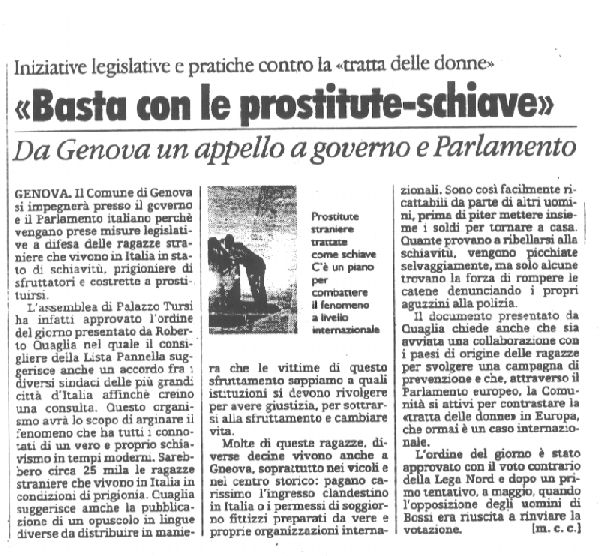
Press Review

The only article that appeared following my efforts was this one, from "LA STAMPA".
Other daily newspapers, such as "IL SECOLO XIX" and "LA REPUBBLICA - IL LAVORO" and "IL CORRIERE MERCANTILE", being newspapers that deal specifically with what happens in Genoa, evidently did not consider it appropriate to dwell on a matter like the one spoken of on this page, which apparently has nothing to do with Genoa.
|
 Italiano
 Deutsch
 English
 Espanol
 Francais
 Romana
 Russkij
 Zhongwen
 Latina
 Portugues
 Turkce
 Arabe
Arabe Farsi
Farsi