The Motion and the related Order of the Day that follow were prepared by Roberto Quaglia, in his capacity as City Councillor of the city of Genoa, in May 1996, and brought to discussion in the Council of the Municipality of Genoa on 4 June 1996

Motion
Evening noise in the historic centre and the phenomenon of its revitalisation
THE CITY COUNCIL
Considering that
- the controversy is ever more lively regarding the phenomenon of the increase in noise in certain parts of the historic centre, following an evening repopulation of it
- a wise strategic approach to the problem is needed on the part of the administration, so as not to compromise the useful revitalisation of the historic centre now under way, and at the same time to protect anyone who should suffer the consequences of acts of incivility committed by some ill-mannered individual
REQUESTS
the discussion of the problem on the floor of the chamber
ORDER OF THE DAY
Evening noise in the Historic Centre and the phenomenon of its revitalisation
Considering that
- the controversy is ever more lively regarding the phenomenon of the increase in noise in certain parts of the Historic Centre, following an evening repopulation of it
- the acoustic discomfort of some residents, while wholly deserving of the utmost understanding, is nonetheless in some respects comparable to that same acoustic discomfort inevitably suffered by those citizens who happen to live in places that are noisy for other reasons, such as proximity to a motorway, a railway, a funfair, hospitals, popular festivals, an airport, industry, busy roads
- it is our opinion that the acoustic discomfort resulting from activities of human vitality and from the phenomena of revitalisation of the ailing "heart" of Genoa should not be regarded as more serious than the analogous acoustic discomfort caused by cars, horns, ambulance sirens, trains, aeroplanes, motorways, popular festivals
- alongside the controversy grows the understandable concern of those who, having believed in the revival of the Historic Centre, have opened venues that perform the useful function of encouraging and accommodating that gathering of young people and revitalisation of the Historic Centre which the city cannot and must not give up
- if it is certainly the administration's task to ensure compliance with the regulations and to carry out monitoring, with the appropriate tactical measures, so that the norms of civil coexistence are respected, it is nonetheless and all the more the administration's duty to state clearly and firmly its strategic approach to the phenomena under way in the Historic Centre, in protection, guarantee and encouragement of those courageous business owners who, through their evening activity, fight and disperse at their own risk the true enemies of the Historic Centre, namely that well-known human and environmental decay which devalues the neighbourhoods and keeps away those who would otherwise frequent them.
Calls upon the Mayor and the Council Executive
- to ensure that in the Historic Centre the administration will not undertake merely tactical initiatives that risk compromising the useful evening revitalisation under way, confirming the conviction that the phenomenon of youth gathering which underlies the said revitalisation is strategically useful for the interests of the city, both in the short and above all in the long term
- to convey to the business owners involved in the ongoing controversy the administration's support, establishing with them a fruitful work of direct collaboration, through friendly meetings and recurring consultations, in order to progress together towards overcoming the contingent problems
- to seek non-traumatic solutions useful for containing the noisy night-time excesses of a few ill-mannered individuals, without thereby in any way repressing the legitimate desire for evening gathering of everyone else
Intervention by Roberto Quaglia (Lista Pannella)
 In recent years, some parts of the Historic Centre, in particular the area between Pollaiuoli, via S. Bernardo and stradone S. Agostino, have begun to be frequented in the evening too. One of the side effects of this phenomenon has been the increase in ambient noise, which has caused understandable annoyance to some residents, and this, in turn, imposes on our administration the responsibility of precise and careful choices. Let us therefore analyse well the phenomenon under way in the Historic Centre, so as to be sure of giving ourselves the wisest approach, for the good of the long-term interest of the city.
The evening noise, which gives rise to the well-known controversy, is first of all a symptom. Before thinking of suppressing the symptom, it is well to understand its causes thoroughly, to see whether they are in themselves harmful or instead virtuous.
The main cause of the noise is a phenomenon of youth gathering, in areas of the city previously abandoned, in the evening, to the lugubrious and unchallenged dominion of the buying and selling of illegal drugs. In every human society people, and above all the young, have a need to gather, and it is right and good that they should do so. Consequently meeting places and bars proliferate wherever people love to gather, and it is right and good that this is so. Of course, we are not used, in Genoa, to seeing evening gathering flourish in the true heart of the city, in that ancient heart which is our Historic Centre. We are, alas, used to perceiving our Historic Centre in the evening as the most desolate and degraded of suburbs, fearfully avoided by our lively fellow citizens, abandoned to the squalid, unchallenged reign of abject drug pushers. We are not used to seeing it, and to thinking of it, teeming with festive life, as it is right that it should be, and as in many other places in the world it is by the sound nature of things. Before the well-known decay swept evening life from our carruggi, the sound of human voices and — why not — the shouts of some drunkard must have echoed every evening for centuries upon centuries in those alleys of ours which were once our entire city. Today, slowly and laboriously, life is returning to animate, spontaneously, the evenings of the Genoese Historic Centre, sustained only by the enterprise of those who have invested their own energies and their own money in the opening of evening bars and meeting places.
Such a phenomenon, deliberately engineered as the result of a precise institutional project, would be the pride and showpiece of any administration. Instead, what we are witnessing is an independent and spontaneous phenomenon. What is happening is a long and difficult process, bristling with inconveniences and incidents, but it is a virtuous process, recently begun, which we must safeguard and encourage for the higher good of the rebirth of all Genoa.
We now know that the future of Genoa will lie in tourism. We know we have the largest Historic Centre in Europe. And were it not for the decay, human and material, it would probably also be the most beautiful. We await with confidence the invasions of tourists. They are a little late, but after all in the past we have done very little to attract their attention, perhaps because we were still stung by the nuisances that our ancient habitual tourists — the Saracens — used to cause us. But today we have understood that opening ourselves to tourism is to our advantage, and the tourists, I am confident, will arrive in droves, and what will they find? This, naturally, depends on us, on all Genoa. Will the tourists find, as they have found until now, an imposing but foul-smelling Historic Centre, lugubrious in the evening, abandoned and dangerous? Let us not fall into the false belief that tourists value a place of stay only for the attractions with which it drew them! Tourists may well come to Genoa to see the aquarium and look at our architectural beauties, but that is an activity accomplished in a couple of days at most. Do the tourists we receive today in fact stay here for more than a couple of days? Tourists remain in a place longer when it captures them with its own offer of vitality, and above all they return only for this. So do we want the millions of tourists who will presumably come to Genoa in the coming years to stay here just two days and then never return? After all, why on earth should they return to see the Aquarium and our monuments again, when they have already seen them? With all there is of beauty to see in the world! No. In all the tourist places of the world tourists go the first time perhaps drawn by an advertised beauty of things, but they linger longer and above all return for the beauty of the people, for the beauty of the sociability they found. Human beings, more than anything else, are interested in other human beings. Why do tourists flock in masses to Prague, to Paris, to Amsterdam, to Nice, to Barcelona, to Edinburgh? It is not only for the beauty of the places, the monuments and the things. Were it so, one could not understand why tourists also crowd into Rimini. To attract tourists every lure is legitimate. But to make them stay, and above all to make them return, one must offer human vitality and sociability.
What, then, will the millions of tourists we hopefully await find, when in the evening, after devoting the day to looking at and photographing the beautiful things we have, they wander through the Historic Centre — and where else should a tourist wander? — in the natural search for life and sociability?
We must work so that they find our alleys teeming with human beings, overflowing with merriment and festivity, bristling with every kind of meeting place, able to satisfy all tastes.
If instead they find, as for the most part they find today, a dying territory unworthily enlivened only by the pernicious, loitering presence of heroin pushers, we will have flushed our future down the toilet.
As has been said, it is a long path, and not without temporary inconveniences. The noise of vitality is one of these, and it is undoubtedly the cause of a certain discomfort for some residents.
Any tactical measure, on the part of the city administration, to reduce and contain the discomfort of some residents, must in no case end up opposing or, worse, repressing the gathering phenomenon under way, which we are now discussing, and which above all constitutes — and it is important that we state it! — a virtuous circle of revitalisation of the ailing heart of Genoa.
If it happens, as indeed it does today, that in the evening the streets fill up BEYOND the capacity of the venues to absorb the flow, this simply means that the venues are still too few. When there are many more of them, spontaneously spread over a wider area, the noise problem will ease by itself. We are therefore now paying the consequences of past short-sightedness. Our action as an administration must therefore be well considered, inspired by a wise and far-sighted strategic vision regarding the spontaneous phenomena under way in a certain part of the Historic Centre. If on the one hand we cannot, and must not, let the interests of those individual residents who are disturbed by a phenomenon that is in itself important and vital for the whole city prevail, it is also true that a mediating action by the Municipality, aimed at tempering the excesses of a few individuals — on one side the noisiest and most ill-mannered youngsters, and on the other the residents who hurl water bombs from the windows — can only benefit everyone's interests. But the mediation cannot and must not and must never have the character of a generalised and indiscriminate repression. The young, wherever they gather, naturally make noise, it is true. It cannot be avoided, short of abolishing the young. City traffic too is noisy and disturbing — I think of those who live a step away from the motorway, or the railway, or an emergency room — but we do not for this reason abolish traffic, nor trains, nor ambulances, nor do we demolish the motorways in the middle of the city. And so, please, let us not demolish the young. On the contrary! Let us encourage their spontaneous gatherings with a far-sighted stance of openness towards those who, in the Historic Centre, promptly respond to their youthful needs by opening new venues. We must help the venue managers solve their problems, which are then also our own, collaboratively, for the higher benefit of our city. But let us not delude ourselves that a certain amount of noise can be absent. The young make noise and disorder, it is true. They do so everywhere and have always done so, and it is right and normal that it should be so. In Venice too the citizens sometimes complain of the noise that the thousands of tourists make in their alleys, in the evening as well. But what would Venice do without tourists? And we, how will we manage if the rebirth of the Historic Centre comes to a halt? At piazzale Kennedy too, with the funfair and the other popular attractions, there are noise problems. Do we want to suppress everything? I think not. Today, in the evening, a part of the Historic Centre fills with young people, with noisy young people. We would like it to fill also with other categories of citizens. Families, middle-aged people, the elderly. In this regard I recall the agreeable words of councillor Evangelisti, dating from a few days ago, with which he looked favourably on a raising of the quality level of those who frequent the venues of the Historic Centre. How can one fault him? It is useful, however, to understand that certain transformations necessarily begin from the "bottom", without here wishing to attribute to the word "bottom" any negative connotation. The vanguards of new behaviours are always youthful. Which is why it is inevitable that the evening repopulation of the streets and venues of the Genoese Historic Centre starts with the young, and initially precisely with the most lively and noisy among them. They will be followed by quieter and calmer young people, and then gradually by individuals of all social categories, in decreasing order of liveliness and exuberance.
Life is returning to the Historic Centre. The administration's primary task is to help it, assist it and encourage it, defending it, if necessary with the same firmness and determination this Council Executive has shown on other occasions. Let measured tactical initiatives indeed be taken towards those few individuals who fail to respect the norms of civil coexistence, but only within the framework of a broad and clear strategic design of support and collaborative solidarity towards that phenomenon of revitalisation of the Historic Centre which has begun, which is prospering and which at all costs must continue its course, if we want Genoa to be reborn, becoming once again, in the coming century, a good place to live.
Roberto Quaglia, 1996
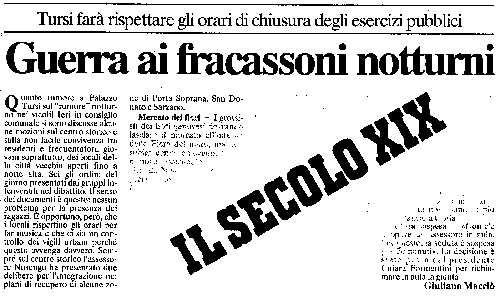
The above Order of the Day was subsequently voted on and approved. Here is the account that the Genoese newspaper "Il Secolo XIX" gave of what was discussed and decided in the City Council.
 Italiano
 Deutsch
 English
 Espanol
 Francais
 Romana
 Russkij
 Latina
 Portugues
 Turkce


